____________________________________

Sunday, March 15, 2026


Selling Books During War


By Terry Whalin @terrywhalin

As a life-long journalist, I follow the news and major world-wide events. While I care about these events, in general they do not touch my work in publishing--but they did last week and this article will tell these stories.

For the last 13 years, Ive worked at Morgan James Publishing which has a global business working with authors and selling books. One day last week, David Hancock, our founder, began receiving a series of texts and emails from author concerned about their books on Amazon being unavailable. As he looked into it, all of our books were not available which was strange and then he learned the reason.

Amazon was shut down for five hours. Why? The Iranians bombed and destroyed two data centers. One of them was in Iran and the other was in the United Arab Emirates (UAE). One of these data centers had the data for Amazon and it took their technicians several hours to restore their service.  

For many authors, Amazon is a key part of their bookselling effort. They are a large Morgan James customer but only 24% of our overall business.  As David Hancock likes to say, we are selling our books in 98% of the bookstores in North America including the brick and mortar bookstores. If Amazon isnt working then you have many different other places to purchase our books. This diversity for our distribution is an important aspect of bookselling. 

Our Morgan James team encourages authors when they set up their websites to “share the bookselling love.” Dont send all your readers to Amazon but include links to other locations like your local independent bookseller, Barnes and Noble, BooksAMillion and give your readers the option to buy an autographed copy directly from you, the author. As an example, look at how I set up my book site for Jumpstart Your Publishing Dreams with these various buy buttons. Notice I include an Amazon button but it is intentionally the last one on the list.

Booksellers do not like Amazon because right or wrong, they believe this company has destroyed their business. Years ago at a conference when I was talking with a bookseller about my Book Proposals That Sell book, with pride, I mentioned this book had over 100 Five Star Amazon reviews. 

“I dont care about Amazon reviews,” the bookseller retorted. It was my last time using this statement. Instead I told about the book having over 100 five star reviews and left out the word Amazon. 

In 2019, Morgan James published a business book from Steve Anderson named The Bezos Letters: 14 Principles to Grow Your Business Like Amazon. As you can imagine, it is impossible to avoid the word Amazon inside this book. As expected when the book released, Barnes & Noble, BooksAMillion and other national bookstore accounts refused to carry and sell the book. Yet The Bezos Letters was a USA Today and Wall Street Journal bestseller (as noted on the cover). Through the years, it has been a steady and continual seller. 

A little over a year ago, these booksellers changed course and began to stock The Bezos Letters. The selling track record of this book overcame their objections about the word Amazon. Booksellers are in the business of selling books to their customers. 

Lessons for Every Author

-Whether we know it or not, as authors, we are a part of a global economy. The war and bookselling can be disruptive to us.

-No matter how you publish, diversity where your books are sold--not just Amazon.

-If you diversity, then a disruption on one online store --even a major one like Amazon--will not affect your book sales.

-Where you publish and their distribution should be an important part of your decision process. As an author, you want your books to be sold everywhere. Then readers don’t have to go to a particular website or location to buy your books. 

-Finally as an author, dont constantly watch your Amazon page then contact your publisher if you see your book is unavailable. Its nothing that Ive ever done with my many books with different publishers. There are better ways to spend your time.

How are you selling your books? Are you diversified or only on Amazon and your own website? Let me know in the comments below what action steps you are going to take. I look forward to your comments.

Tweetable:


Let’s be honest. Publishing is a complex business and much of the process is outside of anything an author can control—no matter how they publish. I wrote 10 PUBLISHING MYTHS to give authors realistic expectations  and practical help. You can get decades of insights in 10 PUBLISHING MYTHS for only $10, free shipping and over $200 of bonuses.

New Podcasts:

In these articles, Ive encouraged you to use PodMatch or some similar tool to book and record podcasts. Last week one more podcast recording launched:


Lou, Teresa and I spoke about how to create a solid book proposal and business plan on the Earrings Off Podcast. Listen to our conversation at: https://bit.ly/4sPu1n9 Then get a free copy of Terry's book at: https://bookproposals.ws/ #publishingtip #writingtip 

Subscribe to Terrys Newsletter:

During the last year, once a week I’ve been sending a short free newsletter. Just follow this link to subscribe. When you are added to the newsletter, you will receive a FREE 87-page Ebook which is packed with insights for every writer.

Get these articles on your email

Since 2004, I have blogged about The Writing Life over 1,800 entries and one of the top 27 content writers. With this simple form, each week you can get my new articles, encouragement and insights at: https://t.co/W6uU64u6aA

Labels: , , , , , , , , , , , , , ,

____________________________________

Sunday, January 04, 2026


Critical Author Habits


By Terry Whalin @terrywhalin

While it was many years ago, I recall my first sip of coffee and the horrible taste.I wondered how or why people drank it. Many people around me were drinking coffee so I continued trying it and developed the habit of loving the taste of coffee. As a young writer, I leaned into the caffiene from my coffee drinking. In my early days of writing, I was drinking a full pot or two of coffee every day. Now many years later, I only drink a couple of cups of coffee but I still love the taste of it.

If you want to learn more about habit formation, I recommend reading or hearing Atomic Habits by James Clear. In 2019, I listened to the audiobook and wrote in my review, “Clear contends to make a new effective habit means developing a system. This audiobook is loaded with insights for every reader. I listened to this audiobook cover to cover and highly recommend ATOMIC HABITS.”

Often in these entries, Ive written in detail about the various personal systems that I use in my critical author habits. I have over 1800 articles in The Writing Life and encourage you to search for a particular topic if I dont include what you need in this article.

Today I want to pull out several of these habits with stories and my encouragement for you to incorporate them into your writing life. 

Consistent Writing

No one sits down and writes a novel or a nonfiction book manuscript. The manuscript is written with a consistent and persistent gameplan. The majority of writers use a word count as their benchmark. For example, they decide to write 500 words (which is about two pages) every day or four times a week or whatever pattern. They select a pattern then do that pattern over and over to get a draft of their manuscript. There are many different types of writing. In the first chapter of Jumpstart Your Publishing Dream, I have an extensive list (follow this link to see it). 

Also professional writers learn how to pitch their work to editors and literary agents. They learn how to write a query letter and a book proposal (no matter what type of book they are writing). Your book proposal is your business plan for your book and will include many important details which is not in your manuscript. The consistent use of these tools is an important habit to develop. If you want to know more about these tools, follow the links that I include. Ive been using these tools for many years to be published in magazines and publishing houses.

Last month in an email, Mike Salisbury literary agent at Yates & Yates wrote about Beth Adams who I met years ago at a Seattle Writers Conference. Mike introduced Beth saying:

Beth Adams is the Editorial Director for FaithWords and Worthy Books, imprints of the Hachette Book Group, where she’s worked on numerous bestselling and award-winning books. She also writes books as a side-hustle and has published over eighty books to date. Every day at 5 am, you can find her on the couch with her laptop and a strong cup of coffee, making up stories. An introverted book lover/cat lady at heart, she lives in Brooklyn with her husband and two daughters.”

Also Mike included Beths advice to writer saying: “Beth: Do it every day. You need to carve out consistent time in your schedule, even if it’s at 5 am, to work every single day. If you write only when you feel like it, you’ll never do it, and if you go more than a day or two without returning to your story, it becomes too hard to get back into it. You have to spend too much time getting back up to speed. But setting a regular rhythm allows you to stay in your work and also forces you to treat it like work, which it is.”

Expanded Connections

Your connections to the publishing world is an important one and should be a part of your habits. Who you know is as important as what you know. Are you continually expanding and using your connections? For example, are we connected on LinkedIN? If not, follow this link and send me a connection invitation.  Publishing professionals move around a great deal and LinkedIN is a great place to begin if you want to connect or reconnect with someone. Often when they move they will take their LinkedIN account with them and their LinkedIN contact information will have this email address. I say “often” because Ive had several recent situations where I know someone has left their publishing role and not left a non-publishing email address in LinkedIN. 

Grow Readers 

Every author needs to be growing readers for their writing. One of the critical elements is in a consistent newsletter. Everyone begins with a small list but the key habit is to consistently use and grow these connections. Ive had a newsletter for many years and my downfall has been the lack of consistency. Over a year ago, I changed this pattern and have een sending my newsletter each week to subscribers. Heres the link to subscribe and with my gratitude you will receive an 87-page ebook.

I spoke with one of my Morgan James Publishing authors who has done multiple books with us. This author knows about the importance of a newsletter but hasnt started one. If you fall into this category, I encourage you to start a newsletter then send it consistently and grow your readership. I understand a newsletter takes continued time and effor. It is another critical author habit.

Continual Learning 

For decades Ive been studying and reading about different aspects of publishing. I continue to learn and experiment with differeent areas. In these articles Ive mentioned doing guest podcasting. In several articles, Ive detailed my process. As new podcasts launch, Ive included the links and the details. During the last year, Ive recorded or booked over 60 podcasts using PodMatch which is connected to over 90,000 podcasts. I encourage you to continue to experiment and learn new skills. At least once a year, get to a writers conference and take a class to open a different type of writing for you. The world is full of opportunity but you have to take continued action for it to happen.

Consistency and Persistence

Reading these words is a good first step but what actions are you going to take for your writing life? How can you develop a system where you consistently move forward? Let me know in the comments.

Tweetable:


Start Your Writing Year with a Bang


Im speaking at the Publicity Club on Tuesday, January 6th from 5 pm to 6 pm Pacific. Im teaching on Seven Simple Actions to Boost Your Publishing This Year. The first meeting is free and herethe Facebook event link with the details. I will be telling some stories but also including an action-packed handout. I hope many of you will attend and get my free resource.


When I’ve worked with different publishers on a variety of  books, I’ve learned the hard way that much of the publishing process is outside of anything an author can control. As an editor, I’ve spoken with different authors about their books, I’ve found many unrealistic expectations. There are actions every author can take with their books. I wrote  10 PUBLISHING MYTHS to give authors practical help. You can get decades of insights in 10 PUBLISHING MYTHS for only $10, free shipping and over $200 of bonuses. 

Subscribe to Terrys Newsletter:

During the last year, once a week I’ve been sending a short free newsletter. Just follow this link to subscribe. When you are added to the newsletter, you will receive a FREE 87-page Ebook which is packed with insights for every writer.

Get these articles on your email

Since 2004, I have blogged about The Writing Life over 1,800 entries and one of the top 27 content writers. With this simple form, each week you can get my new articles, encouragement and insights at: https://t.co/W6uU64u6aA

Labels: , , , , , , , , , , , ,

____________________________________

Sunday, November 12, 2023


The Only Path to Success


By Terry Whalin
 @terrywhalin

It sounds counterintuitive. The only path to success is through regular failure. To consider this topic, let’s begin with a couple of stories. 

Thomas Edison invented numerous inventions which we continue to use today--like the light bulb. “But despite his outstanding success, Edison failed frequently. In fact, it sometimes took thousands of attempts – literally – to perfect his experimentation. That was exactly the case when Edison was working to devise a novel storage battery. According to his close friend Walter S. Mallory, Edison had already tried 9,000 experiments and hadn’t yet found a solution. When Mallory commented about the lack of results, Edison promptly responded, “Results! Why, man, I have gotten lots of results! I know several thousand things that won’t work!”

Or consider James Dyson and his 5,126 failures to invent a vacuum cleaner. acuum cleaner. “That’s how many failures James Dyson went through before finding the winning prototype for his first vacuum cleaner. Five thousand — one hundred — twenty-six! That meant four years of developing the product, going deep into debt and putting up his house as collateral to the bank loan. He pinned everything on this invention without any guarantees that it would ever work. That level of determination and patience is absolutely mind-blowing to me. James is now the fourth richest person in the UK with an estimated net worth of £16.3 billion. Well deserved, I say!”

As writers, we face a great deal of rejection. Many people have forgotten those early days of finding a publisher for Jack Canfield and Mark Victor Hansen, the co-authors of Chicken Soup for the Soul (one of the bestselling series in the English language). Their submission was rejected 140 times which is a lot of rejection. Yet they continued looking for a publisher. Mark wrote this story in the foreword of my book Jumpstart Your Publishing Dreams. Follow this link to dowload a free section of this book including the foreword.  

If your work is getting rejected from editors and literary agents, keep submitting and writing. Your persistent effort will pay off if you continue looking for the right fit for your work. I admit the path is not an easy one. Ive been rejected many times in my own journey. Ive come to understand that rejection is not person but saying my writing was not the right fit for that particular editor or agent. I have to keep submitting and keep connecting with new people to find the right fit for my work.

The process or journey is not easy but possible. I encourage you to: 

--keep making new connections. Who you know is almost as important as what you know.

--keep learning your craft and reading how-to books, articles and online courses. Ive been studying publishing for decades and continue to learn new aspects all the time. 

--keep trying new types of writing. In the free excerpt from Jumpstart Your Publishing Dreams, I have a detailed list of the variety of writing. You may not be a book author but you may be excellent at magazine articles. Its a conversation I had recently with a contributing editor at Guideposts (one of the top circulation publications). She hasnt published a book but loves writing short magazine articles and reaching millions with her writing.  

The only way to fail in your publishing efforts is to quit the journey. I encourage you to continue to move forward on the only path to success. Let me know what you think in the comments below. 

Tweetable:

Labels: , , , , , , , ,

____________________________________

Sunday, June 11, 2023


The Important Search Tool


By Terry Whalin
 @terrywhalin

Several times a week, writers will ask a question about something related to writing and I turn to an important search tool. Its right in plain sight but I suspect few people know about it or use it. In this article, I want to call attention to this important search tool which is on my blog.

To locate this too, you have to go to my blog on The Writing Life then scroll down to find the tool. Here's what you are looking for:

After you find it, change the search button from web to my blog. Then type in your specific word or phrase to locate entries which have this information.

Since 2008, Ive been writing each week about publishing and the writing life. Ive covered many different topics from my perspective as a working writer and an acquisitions editor at three different publishers.  Often throughout my week, I will be talking with writers about publishing. I will use this search tool to find specific articles which I email to them.

Over the years, Ive written about different attributes of writers like consistency and persistence. Also Ive covered writing for magazines, devotional writing, book publishing, proposals, query letters, work made for hire, contracts, marketing, social media and much more. You can use this search tool to look for these articles and learn for your own writing life. 

No single person has all of the answers to your various questions but I believe we can learn (and continue to learn) from each other. Through the years, I have written about my various editorial and publishing experiences in these entries. I encourage you to tap into this search tool as another consistent source and tool to gain publishing insights and wisdom.

Do you have a search tool on your blog? Why or why not? I encourage you to add it and make it easy for others to search your blog. It is simple HTML which I added to my blog years ago and continue to use often. Let me know what you think about this search tool and how you can use it on your website or blog in the comments below.

Now that you know about this hidden gem, you can use it too.
 
Tweetable:

Labels: , , , , , , , , , , ,

____________________________________

Sunday, August 07, 2022


How To Fill Your Empty Calendar


By Terry Whalin @terrywhalin

Like most freelance writers, I have an empty calendar for many days. How do I fill that schedule with productive activity that moves me forward toward my goals? In this article and no matter what you write, I want to give you some ideas about how to fill those blank and empty periods.
 
1. Determine what you want to write or achieve. Do you want to publish in magazines? Do you want to do more speaking? Do you want to write books for others? Do you want to learn about how to write screenplays or do effective Facebook ads? There are many opportunities and you have to determine which one is where you want to go. If you are looking for a list of writing possibilities, then download the first chapter of my book, Jumpstart Your Publishing Dreams. Use this download link (no optin). 
 
2. Focus your planning and energy toward consistent effort to this goal. To achieve it, what do you need to learn? Who do you need to connect with? How can you build those relationships? It will not be overnight but you have to consistently make the effort to achieve this goal.
 
3. As you get responses, fill your calendar with scheduled phone calls or meetings to build your relationships. As I've mentioned in the past on these articles, who you know is just as important as what you know. Your connections can be invaluable in reaching your publishing goals.
 
I don't expect this process to be easy or simple and know will involve hard work and continued effort. Here's what I have learned from decades in this business, if you do the work, you will eventually achieve the results. I recently listened to Darren Hardy's The Compound Effect about where you can achieve big results from making incremental changes. There is a payoff for making these changes with consistency.
 
As I put together my calendar, balance is a key component. I'm not perfect at it but overall there is a mixture between current work, optional work, planning ahead for future work and consistent learning and growth.
 
For this process, I don't use a paper calendar. Instead I keep dates and appointments on my electronic calendar. I made this switch several years ago and it has been a good one because in general I have my phone with me and can keep up with my variety of deadlines.
 
My Personal Philosophy
 
For a number of years, I've been an early riser with no alarm clock. Yes, if I have to get up at 3 am (which happens sometimes to catch an early flight), I use my alarm but otherwise I don't. For me every day is a gift and we are charged to use that gift wisely—whether it be a regular work day or a holiday or the weekends. I have many different activities which fill my day. Some of them are on my calendar as appointments but others are just work activities that I want to get finished. Some of those activities relate to current work while others relate to future work. Some activities are something new that I'm learning. Others are consistent ways I spread the news to others about my work and effort such as marketing efforts. I'm often in a routine which I've created but I consciously work at changing up that routine so it is different and not boring. I believe each of us have a lot to accomplish in a given day—if we celebrate and seize the opportunity.
 
How do you fill your empty calendar? What steps or ideas can you add to what I've said? Let me know in the comments below.
 

Labels: , , , , , , , , , ,

____________________________________

Sunday, April 03, 2022


Where Is the Easy Button for Publishing?


By Terry Whalin @terrywhalin

Writing is easy. You sit at your keyboard, open a vein and bleed. This statement has been attributed to Ernest Hemingway. On the surface, publishing looks easy. You write a book and publish it. People are looking for something easy—an easy button. One of my friends, Joel Comm, was selling easy buttons that you could have on your desk and push when you needed it. Yet the button only went up and down—and didn't do anything. From my decades in publishing, there is no easy button and instead the days are full of many “minor” decisions which will make a huge difference in the success or failure of your book.
 
In the pages of these entries, I've told the story about Mark Victor Hansen and Jack Canfield, co-authors Chicken Soup for the Soul (one of the most successful series of books in the English language). People often forget these books were rejected 140 times before they finally found a small publisher. That is a lot of rejection. Mark tells the story in the foreword to my book Jumpstart Your Publishing Dreams. Just follow this link to download and read the foreword and first chapter.
 
Last year, on The Write Conversation blog, I told the story of Andy Andrews and his struggle to get published and then how he became a New York Times bestselling author. Follow this link to read this article but the key fact is to notice the persistence and perserverance Andy did to finally succeed with his books and writing. There was nothing easy about it.
 
A great deal of publishing is being in the right place at the right time with the right stuff. Those qualities of persistence and perserverance are key elements for every writer. Here's some ideas of action steps you can take—no matter where you are on your publishing journey:
 
1. Write shorter pieces or magazine articles and be pitching them to editors. It takes skill to write a book and it also takes skill to write a shorter article. I would rather be learning on the shorter article than the longer book. Plus you will reach many more people with an article than most books. I continue to write for magazines and have been doing it for many years.
 
2. Be making connections consistently through LinkedIn. Millions of people are on this business network and I ignored it for years but today I have over 19,000 connections. Last week I called a long-time friend's cell number and someone else answered. I checked the number with a colleague—and they had the same wrong number. I went to LinkedIN and found a different number in this friend's contact area—so I called it and left a message. I was reaching him with an old number which was forwarded to him—and apparently dropped during the last month.  Repeatedly LinkedIN has been a great source of information because generally when people move or change positions, they take their LinkedIN account with them. Each of us need the right connection and you can be expanding your network through LinkedIN. If we aren't connected, then send me a connection invitation (use the link) You might not need it today but maybe you will need to connect at a later point.
 
3. Get to an event and make new connections.  After two years of a pandemic, live events are returning. I will be at two of them this month and another in June. In May I will be teaching and meeting authors at a vircual event. Follow this link to see my schedule and possibly meet. This week an author who attended one of my workshops in 2018 reached out to me with some questions. She was going to attend the Write His Answer conference in May (which will be virtual and a combination of the Philadelphia and Colorado Christian Writer Conferences). This author was surprised that I answered her email and questions. Even four years after an event, I continue to be in touch with people that I met.
 
Your persistence and consistency is important—even in the face of rejection like Jack Canfield, Mark Victor Hansen and Andy Andrews. Keep moving forward is my encouragement—whether you find the easy button or not. 
 
If I'm missing the easy button for publishing, let me know in the comments below.
 

Labels: , , , , , , , , ,

____________________________________

Saturday, March 26, 2022


Where Do You Get Educated About Publishing?


By Terry Whalin @terrywhalin

For years I've been studying the publishing world. A key part of the process is building relationships with editors and agents and others in the community such as publicity people. Something you can't control is timing but you can continue to be submitting or pitching and building relationships. Then you can be at the right place at the right time with the right material.
 
The publishing community is always changing and I can illustrate it with one of my 21 “secrets” in the first edition of Book Proposals That Sell: always enclose an SASE (self addressed stamped envelope). At that time, there was no electronic submissions. Publishers received thousands of submissions (as they do today) and if you didn't include the return postage, then your submission was thrown away and not returned. Today everything is electronic and if an editor is interested, they will request you to send the full manuscript as an attachment.
 
How can get educated about publishing? It is an on-going process but in this article I want to give you several resources. My first resource is to read the articles in my Twitter stream or that I post on LinkedIn. It is a steady stream of information about various aspects of publishing and education. I read all of these articles which are in this steam and learn from them.
 
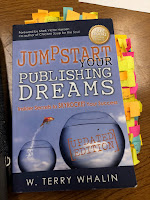
The second way to learn about publishing is to study how-to-write books. For years I've been reading at least one how-to-write book a month and learning from them. You can get them from your public library and read them. I've written three how-to-write books. Originally I self-published Jumptart Your Publishing Dreams but now the revised edition is available in bookstores online and brick and mortar stores. Follow this link for a free sample. This book has helped many writers learn more about publishing. Check out the illustration from a reader who marked different sections to study with post-it notes.
 
I also wrote 10 Publishing Myths to help writers have a realistic view of publishing. You can get my book for only $10 including shipping plus over $200 in bonuses if you follow this link. Or you can get it at any bookstore whether online or brick and mortar. I encourage you to get the 11th myth as a free download.
 
Finally the revised edition of Book Proposals That Sell will help you understand the book publishing world and many authors have used this book to find a publisher or a literary agent. At the book website, you can get a free book proposal checklist (the pop-up when you go to the book site).
 
Another means to get educated about publishing is to attend a writer's conference. There are some excellent events and opportunities for you to meet personally meet editors and agents. I'm headed two two of these live events next month and would love to meet with you during these events. 
 
The publishing world is full of opportunity for every writer but you must take action, learn what the editor or agent wants and expects, then make appropriate pitches. Each of us can get educated about publishing and I've given you some seasoned places to explore and improve your possibilities.
 
In this article I gave you a number of different means to get educated about publishing. Are there other ways you would suggest? Let me know in the comments below.
 

Labels: , , , , , , , , , , ,

____________________________________

Sunday, October 10, 2021


Gratitude and Subtle Changes


By Terry Whalin @terrywhalin

Last week over 30 people on my launch team did remarkable work on various book review sites like Barnes & Noble, Books A Million, Goodreads and Amazon. They wrote reviews about Book Proposals That Sell, 21 Secrets to Speed Your Success (The Revised Edition). It was an amazing experience to read reviews on Medium and other places.
 
Through the years I've written many reviews of books for print publications, Amazon and Goodreads plus promoted those books on social media. It's one of the ways that I support other authors and tell people about worthwhile books that I've discovered. I'm full of gratitude for each of these people who last week made this sort of effort for my book. With many new books releasing each day, it's not easy for any book to get reviews or attention in the market. I understand firsthand the effort it takes to write a good review about the contents in a book, then get it posted on one of these sites.
 
Years ago I wrote Book Proposals That Sell to help editors and agents get better submissions and also to help writers receive publishing contracts and better reactions. The reality of the publishing world is a huge volume of material is being submitted to editors and agents. When something is rejected, you often get a form rejection letter (if a response at all). These form rejections say something generic like “it wasn't a good fit for us” but do not give you any information about what you can do to improve your submission for the next time you send it out (if you send it out at all. Many people get rejected a few times, give up and stop submitting their work. Every book needs a proposal or business plan—even if you self-publish or write fiction or write children's books or write nonfiction books. I'm delighted to get the revised edition of this book back into the market to help a new generation of writers.
 
Subtle Changes From the Launch
 
Because of the release of Book Proposals That Sell, I also made a couple of design and image changes.  First, I changed my header on the top of my Twitter profile to emphasize the new book. Also this images tells the reader how to get a free Book Proposal Checklist. I have a pop up button for it at my book website or you can go to this site and sign up for the Book Proposal Checklist.  In the past I had a one page checklist but I've made this checklist into an 11–page free ebook.
 

My second change is something I've not done in years: I changed the image at the top of this blog on The Writing Life. I published the first entry in this blog December 31, 2004 and yes, I have been blogging each week for a long time. The original design included a book laying on the cover of a keyboard. That book was Book Proposals That Sell (the original edition). The designer built a subtle element (which I suspect no one has ever used) and I didn't call this element to anyone's attention—but I'm doing it now. If you move your mouse over the book laying on the keyboard AND click the book, it will open up a window and take you to that book location.
 
Years ago when I published Jumpstart Your Publishing Dreams, I changed the clickable book on the design to Jumpstart Your Publishing Dreams. In celebration of the revised edition of Book Proposals That Sell, I changed the book a third time (and the book is still clickable to take the reader to the book website).  Finally I changed the template header for my email subscribers. Everything matches.
 
I've written these details today to help you see the types of changes you can also make to your own website, Twitter profile and blog, when you launch a book or have any other special event. When you publish a new book, do you make these sorts of changes? Ir maybe you change something else in this process. Let me know in the comments below.
 
Tweetable:

Labels: , , , , , , , , ,

____________________________________

Sunday, August 08, 2021


Writers Must Wear Many Hats


By Terry Whalin @terrywhalin

As a writer, I get a lot of enjoyment telling stories—whether the stories of others or my own stories. Crafting those details on my computer screen is a lot of fun. Yet as a writer, the task is much more diverse than just telling stories. As writers, we must wear many different hats and play many different roles.
 
Many years ago as a young journalist, I learned a life-long lesson about myself and what I do.  I love to write, craft stories and put these words on paper then figure out how to share them with the world. Admittedly many others want to do this skill as well and at times it is a challenge to make a living in this work—but possible. There are many ways to use your writing. Many people focus on books but your writing can be used in many different ways. I detail some of the possibilities in the first chapter of Jumpstart Your Publishing Dreams. Get this free chapter here and look at the different writing possibilities.
 
I've written more than a dozen books for other people as a co-author and a ghostwriter. As a part of that writing process, I get to pretend to be in the mind and shoes of that other person. This little mind trick is one of the ways to successfully write those stories for others. As a part of my writing life, I spent 17 years with Wycliffe Bible Translators. Ten of those years were in linguistics then I returned to my writing and began writing for magzines and eventually my first book was published. During this period, my children were small and I would do some of my writing at the Wycliffe office—often on a Sunday afternoon. Almost no one was at the office during this period.
 
I noticed a light on in the director's office. On the way to my office I walked past to see who was there. To my surprise it was bestselling author Jamie Buckingham. Twice a year without any fanfare, Jamie came to our office and wrote the donor letter and various articles for our Wycliffe director. His name never appeared on these articles but Jamie was the storytelling pen behind this writing. He would tell me, “Terry, today I'm a jungle pilot in the jungles of Peru, South America.” I met people who gave to many different missions and said they normally tossed the donor letters and did not read them—but every time they read the Wycliffe donor letter. They loved trhe storytelling in that letter and behind it was the pen of Jamie Buckingham.
 
As a writer, we need to learn to pitch our work to the media, to editors and to literary agents. We have to learn to write documents called “book proposals” and others called “query letters” in this pitch process. Some people would call this pitching process, marketing. Your writing just stays on your own website or your own notebooks if you don't learn to pitch. It's another skill you need to learn and develop as a writer.
 
Also writers have to become editors—at least of their own writing. I will often write something, set it aside for several hours or days, then return to it and rewrite or edit it. Editng your own writiing is a skill each of us have to develop and then use over and over as writer.
 
Writers are also researchers to compile information and find interesting facts and statistics. We have to learn to ask good questions to get the stories and information that we need from others.
 
As our books get published, we have to become proofreaders (or hire an expert at this point in the process). Also in this process we need to gather endorsements and have to be connected to others in order to get these endorsements. Networking and your connections to others as a writer is another important skill or hat.
 
In this article, I've given you a starting point. We need a diverse set of skills in this business or wear multiple hats. Which hat are you wearing today? Have I missed some roles or hats? Let me know in the timments below.
 
Tweetable:

Labels: , , , , , , , , , , , ,