The Craft of Storytelling
By Terry Whalin @terrywhalin
Labels: Angela Hunt, Colleen Coble, DiAnn Mills, first story, insights, Jerry B. Jenkins, Nancy Moser, novel, publishing, Terry Whalin, The Craft of Storytelling, The Writing Life
Labels: acquisitions editor, authors, book, book proposal, fit, historical fiction, literary agent, novel, publishing, publishrs, writers
Labels: All In, Bookmates4Inmates.com, Bret Ridgway, Bryan Hane, fiction, L.K. Simonds, ministry, Mistakes Authors Make, Morgan James Publishing, novel, prison, publishing, resource, Rick Frishman, video, writing
Labels: author, bestseller, Calvary Chapel South Denver, Joel C. Rosenberg, Ministry Architecture, novel, publishing, writing
Labels: Advanced Reading Copies, books, Brad Meltzer, expectations, nonfiction, novel, reading, realistic
Labels: acquisitions editor, fiction, hook, Marc Rubenstein, media, Morgan James Publishing, nonfiction, novel, readers, Weddings by the Glass
Labels: Book Marketing, books, marketing, nonfiction, novel, Penny Sansevieri, persistence, proposal
Labels: bestseller, Daniel Silva, fan, follower, Jamie Gangel, novel, platform building, reading, Today Show, Willie Geist
As a long-time publishing professional, I love a good story. Over the next few days, I'm reading Daniel Silva's The English Girl. I'm a long-term fan of Daniel Silva's writing and have read all of his other books. Former President Bill Clinton has called Gabriel Allon (the lead character of Silva's books) one of his favorite fictional characters.

Labels: book, Book signing, Daniel Sliva, fiction, Gabriel Allon, novel, President Bill Clinton
Recently a fiction author sent an email query to my literary agency about his work. He had a Christian contemporary novel and expressed his frustration about the lack of response and attention from editors and agents. In fact, that attitude seemed to ooze out of his pitch letter (which should have been a bit of an indicator to me).
If you read these entries, you know that as an author, former book acquisitions editor and now a literary agent, I want to help writers understand the marketplace and become more successful with their pitches. Most writers have no understanding of the sheer volume of submissions which editors and agents receive. Dan Poynter in The Self-Publishing Manual estimates there are millions of proposals, manuscripts and queries which are circulating around the country. I have a small portion in my office so it doesn't take much for me to believe that number.
For this novelist, I told him that nonfiction out sells fiction and that there are more people trying to write fiction than nonfiction--but if he still wanted to send me his proposal and sample chapters, then I would have a look and get back to him.
Even with my caveats, this author sent me his material. Late one night recently I pulled his submission out of the envelop to have a quick look at it. His synopsis was OK then I flipped to his sample chapters--which started at Chapter Two then also threw in Chapter Eleven. Yes, the sample chapters were two and eleven!
I've read hundreds of these submissions and I still see authors select random chapters from a novel to send to the possible agent or editor. It makes no sense to me. When I pick up a printed book in a bookstore, I don't start reading in the middle. I turn to the opening pages and see if I like it. If I like the opening, then maybe the rest of the book is worth purchasing. The opening chapter lays the groundwork for the whole novel. It introduces the characters and the setting and the difficulty or problem for the entire book.
It's also true for a nonfiction book proposal and sample chapters. The first chapter is critical because like in the novel, it lays the groundwork for the subsequent chapters. It's almost impossible to evaluate a work from looking at the middle of it.
Let me close this entry with six steps to stand out in your submission:
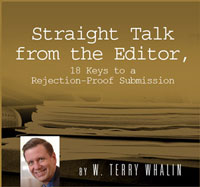
1. Use my tips in Straight Talk From The Editor -- the free Ebook.
2. Send a complete proposal and the initial chapters of your writing and only send compelling writing.
3. How do you know if your novel or nonfiction is compelling? Check it out with a colleague. Join a critique group. Write and rewrite it and please don't fire it off without some serious thinking about how it will come across.
4. Check and double-check the name you are sending. Even this past week, a writer queried me at my submission email address for the agency which began, "Dear Ms. Wagner..." When I wrote the author asking about it, she apologized and her second attempt began, "Dear Mr. Whalen..." These exchanges happened rapid fire and within a 20 minute period. If you didn't notice, she misspelled my last name. I fired back with a form rejection. I don't need to work with such sloppy submissions. Yes she made an impression but not a good one.
5. Continue to learn what factors in a proposal or submission make an editor sit up, notice and get excited about it. One of the best tools that you can easily use is the session I did with eight different top editors and literary agents called Secrets About Proposals. Go over there and access this information, download the audio, listen to it. Then download the written study guide material, print it, read it and study it.
6. If you are looking for an agent, make sure you get my free list of agents and also that you look at this short two-minute clip from David Henry Sterry about the easily overlooked art of agent research which on the Media Bistro site. It's common sense but few writers actually take these wise steps.
These actions will dramatically increase your possibilities for having your idea seriously considered. It's all any writer can ask from an editor--that their idea be seriously considered. Like I've mentioned before in these entries, your search as an author (and my search as an agent for my clients) is to send the right idea at the right time to the right place to the right editor. Yes, I understand there are many "rights" in the previous sentence. You are looking for a match.
Labels: book proposal, nonfiction, novel, pitch, secrets about proposals
In these days of unreturned phone calls and unanswered emails (yes it happens to me too), at times, it's easy to wonder if you are making a difference. If so, where are you making that difference in the lives of others? From my experience, it will take a conscious effort on your part.
Are you learning something new? It seems like every time I turn around I'm gaining some new bit of information. What are you doing to be a good steward of that information and pass it on to others?
For example, in my agency, someone contacted me with a 190K novel--which is over the top too long. Go to this entry and follow the links if you want to know more about the expected length of novel. Why is this important? Because if you have a mass of material coming your direction as an editor or agent (and we all do), then one of the quickest ways to sort things into the rejection pile is based on word count. A huge manuscript is going to take a tremendous amount of editorial work to get it to the right length if it is too long. Several months ago, I rejected a novel on the basis of word length. Today this novelist came back and said she had managed to trim her 190K novel into 120K would I now take a look? I was flattered that she had taken the time and energy to cut her story and maintain plot lines and other things (according to her note). Yet it was still too long in my view to capture my interest. From my experience anything over 110,000 words is going to struggle to find it's place of publication in the marketplace. So it's not a good use of my time as an agent--and I told her so.Thank you but still no thank you.
Then I got another submission addressed to my personal mailbox, and misspelling Literary in the name of my agency. Yet on the inside the submission began, "To Whom It May Concern" and also did not include a title for their proposed novel. I could have just returned my standard rejection letter but I made a point to call it to her attention so she could change it in the future.
I recently wrote about Mark Levine's book on the Fine Art of Self-Publishing. I have personal connections to two of the Print On Demand publishers in the "Publishers To Avoid" section of the book. I could have ignored it but I didn't.
Instead I brought the information to leaders in each of these two publishers. One publisher had moved from the recommended category to the avoid category and when I told her about it she said, "Why whatever it is, we will fix it." The other publisher made the opposite choice with the information saying, "We weren't fairly treated and this book doesn't know what they are talking about."
Many years ago I learned that when you bring information to someone they have two choices. They can either resist and contend that you do not have the full picture, then make some excuse. Or they can make an effort to grow and learn from the situation. I try to take that latter road and grow as much as
possible.
I continue to grow and improve. Recently I held a free teleseminar about book proposals at Askterrywhalin.com. After the teleseminar, I changed the material into the replay mode--but the date remained on the front page (which is not supposed to happen). It could have thrown me off and stopped me from holding additional teleseminars. It hasn't. The date was also on the teleseminar I did with Andy McGuire (see the illustration).
I'm still going to be conducting more of these worldwide events. How do I know they are worldwide? The other night one of the callers on the phone was from Italy--a long ways from Scottsdale, Arizona. Note this teleseminar is now on replay mode. If you would like to hear it for free, simply fill out your first name and email address and write "no question" in the box and you will reach the replay page where you can download the full hour for your computer or iPod plus pick up the 90-page Ebook about book proposals.
As you can see from this second illustration, my date problem has been resolved. Apparently I was missing a line of computer code some place and now my various teleseminars which are in replay are working.
My encouragement is for you to pass along the lessons that you are learning to others. You can make a difference in the lives of the people around you.
Labels: book proposals, difference, length, novel, teleseminars