____________________________________

Wednesday, July 20, 2011


Overcome A One Star Review on Amazon

It is a shock to check out the customer reviews on Amazon and learn some reader has found your book worthy of a one star review. I've had it happen. I'm even including an image to show you the one star review. Yet it can be overcome and I'm going to give you the details.

Amazon has the biggest online bookstore on the planet. Yes they sell much more than books but if you have a book, you want to pay attention to the customer reviews on the page. Readers are constantly reading these reviews and making a buying decision about your book from those reviews.

I love books and regularly read new books. One of the ways I support good books is to take a few minutes and write a short review of the book and a rating on Amazon. I'm often surprised when I go to the book on Amazon and discover three or four reviews. Or often I'm the first person to write a customer review about a book. It did not happen in an instant but I've continued building a body of work through these customer reviews and I've written over 330 Amazon reviews. Many of them are positive because I'm writing the reviews to support authors that I love their writing. In some cases they are controversial. For example, check out the reviews of Malled: My Unintentional Career in Retail by Caitlin Kelly. While the book has only been out three months, it has a mixture of positive and negative reviews. People either love this book or strongly dislike it. Here's the permanent link for my review of Malled. It is worth reading and I enjoyed this book.

The Shack by William Paul Young has been rooted in mixed views since it was published. People either love or hate this book but it continues to be a bestselling book. At this writing, it has over 4,600 reviews. Notice the mixture of almost 3,000 Five Star reviews and over 800 One Star reviews. Yet because of the overwhelming majority of Five Star reviews, the average is Four Stars for this book.

The key fact that many authors overlook is that the Amazon stars are averaged. If your book has dozens of Five Star reviews, then you can overcome any low reviews. Now if you only have one or two reviews for your book, then a low review has a lot of impact on the average.

If you have a book, here's several ideas for you with your Amazon page:

1. Monitor your page on a regular basis. Many authors ignore the page where their book is located. I regularly check these pages for my books and note any activity.

2. If someone has written a Five Star review, then use that information. Tell others about it. When I see that anyone has written a Five Star review about my book, then I tweet about it to my followers with a link to the review. These tweets generate even more buzz about your book.

3. It does not have to be a new book. Also work on your older books. For example, my Book Proposals That Sell has been out in the market for years. Currently there are over 95 Five Star reviews on Amazon.

4. Whenever anyone emails me about how my Book Proposals That Sell helped them, I respond back in appreciation then I ask them to go over to the Amazon page, cut and paste those sentences along with a Five Star review (and I remind them that the Five Star review is important because the stars are averaged). Not everyone takes action and writes the review—but a certain number of them will post the review.

As you increase the number of Five Star reviews for your book, you are also protecting your book when you get a one star review. As you can see from the illustration from my page at Book Proposals That Sell, I have a few one star reviews. In spite of those reviews, my average is still Five Stars. You can overcome a low review if you are aware and working at it.

Whether you have written many books or no books, do support books with simple straight forward reviews on Amazon. You will be making a difference and helping others make wise buying decisions.

AddThis Social Bookmark Button

Labels: , , , ,

____________________________________

Wednesday, December 03, 2008


Where Do Readers Get Books?

Whenever I discover information in this area, I'm always interested to read it carefully. The cover story of the December 1st issue of Publishers Weekly is called Looking At Who Buys What Where, examining book consumers with Bowker's PubTrack.

Which groups buys most of their books online? Generation Y (ages 18-28).

Notice which group purchased the majority of their books in the chain bookstore teens (ages 13 to 17). On the surface you would not think teenagers would primarily purchase their books in a chain bookstore but that's the data in this article.

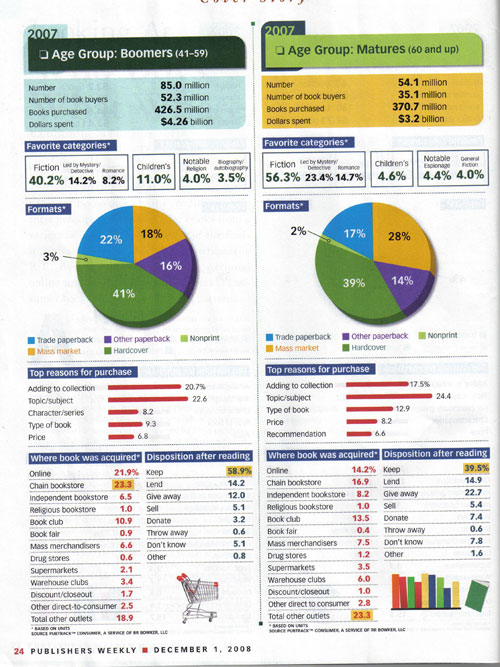
While Publishers Weekly included the various statistics in their article, I was fascinated with the graphic illustrations. I've included the one below which relates to Boomers (ages 41 to 59) and Matures (60 and up):

Let me call several of these statistics to your attention. These older readers had the highest numbers in the area of book clubs. While the overall numbers at book clubs have been declining in recent years, 13.5% of mature readers got their books from this source.

Last night, I was looking for the Writer's Digest Book Club, where I have purchased books on a consistent basis for over 20 years. I'm not a current member and was surprised to see the parent company has ended this book club since they are no longer accepting new members. What can you learn? They looked at their numbers and determined the profitability margin wasn't there so they ended that opportunity. Writer's Digest continues to publish a limited number of new titles but they have obviously cut this area of their business model.

What does this mean for you as a writer? You need to understand where your audience buys books then target those markets with your own visibility and publicity efforts. Also the message that I get from these statistics is diversity is more important than ever. You need to get into as many different channels or areas of the market as you can get. You can not depend on your publisher to cover all of these areas but as the author you need to actively be involved in as many different channels as you can. Why? You never know which channel or opportunity will lead to your break through moment. You can not count on one area but need to be diverse. Understand that more than half of the books sold are sold outside of the bookstore. It's why you need to be reading books like Beyond The Bookstore by Brian Jud--and not just reading it but studying it and using this book to stir opportunity.

The opportunities are there for you. Are you using them? If not, make a plan to move forward, then work your plan.

AddThis Social Bookmark Button

Labels: , , ,

____________________________________

Friday, July 25, 2008


Use Your Book For Leverage

Are you leveraging the power of your book to engage your reader? You may be wondering what I'm talking about since many people see the book as their end goal. These people are trying to learn the craft of writing and take the necessary steps to get their ideas into print--which is a great starting place in the journey.

The book isn't the end but it's the beginning in many regards. Repeatedly I've heard my friend Alex Mandossian say, "People do not make money writing books (true). People make money explaining books."

I've probably burst a few people's dream with those words about making money writing books. In the last few days, I've read Patricia L. Fry's excellent book, The Right Way To Write, Publish and Sell Your Book (more about this soon). Fry writes on page 14, "The Author's Guild has determined that a fiction book is successful if it sells 5,000 copies and a successful nonfiction book sells 7,500 copies." Arielle Eckstut and David Sterry write in Putting Your Passion Into Print that less than 10% of books published (yes fiction and nonfiction) ever earn back their advance. These statistics are the norm and you could break out of the norm but realize what you have to overcome and leverage to make that happen. While hope springs eternal, it is good to root your hope in reality.

I was stirred to think about this concept of leverage for books earlier this week with a thought-provoking post from Paul Mikos at Cumberland House Publishing. As Mikos wrote in his post quoting Michael Cader from Publishers Lunch another source that I will also use, "The book, Cader said, 'is the [most] meaningful place for you to have meaningful interaction with your readers…When I finish a book, I want to know what to do next… Can I write the author? … Is there a club? … If there's a Web site, don't just give me a URL, tell me what's good there.' [Cader's] larger message: 'Get your mind-set out of the book business and into the reader business.'

Mikos pointed me to read this article from the EDITOR-IN-CHIEF Noelle Skodzinski. Here's the paragraph from this article that I want to point out: "Books have a power, for many of us, unparalleled by television or movies. We grow strangely attached to the characters. I recently finished reading “Water for Elephants” and didn’t want the story to end. I wanted friends to read it, to share the experience. And I definitely want to read another book by Sara Gruen. Fortunately, the publisher was smart enough to tell me what other books she has written."

www.ProposalSecrets.com

How are you leveraging this power in your own books and creating products which explain your book? Are you doing it through a regular newsletter where you connect to your readers? For example, several years ago I wrote Book Proposals That Sell, 21 Secrets To Speed Your Success. While the book is available instantly in an Ebook format, it is also in a paperback on Amazon, Barnes & Noble and many other places. It is important to give the book to people in as many different formats as possible. In addition, I created several products like the audio interview with eight top editors and literary agents in publishing called Secrets About Proposals. As another tool, I'm providing daily proposal coaching through another product, Proposal Secrets. Or I've provided an audio package of my teaching about book proposals called Editor Reveals Book Proposal Secrets.

Each of these products is an example of how I'm leveraging my book and focused on attracting readers and growing the audience. You can follow the same pattern.

AddThis Social Bookmark Button

Labels: , , , , , ,

____________________________________

Monday, June 09, 2008


Take A Re-Org Day

Late Saturday night, I returned home from the Write to Publish conference on the campus of Wheaton College. As I've mentioned in other entries on The Writing Life, I love to go to these conferences for several different reasons. They are an opportunity to encourage and give back to others in the writing community. Often there are many people new to the publishing community and it is an opportunity to encourage them. In addition, I always grow and learn new things which build into my own writing life.

The marketplace continues to change. One long-term magazine editor confided that she was working on the final issue of the publication which she had led for the last few years. Thankfully she still has a position at the company and is shifting to another magazine. My conversation with her served as another reminder about the continual ebb and flow of the magazine market--something that many writers don't consider. Just like the book industry changes constantly, change is a constant variable within the magazine community as well. While there are many new magazines introduced into the marketplace each year, many magazines fold and go out of business. For me, a number of years ago I gave up counting the number of publications where my work has appeared when I reached 50 publications. In a short amount of time, I could compile a list of magazines where my work has appeared and these publications no longer exist. Many magazines cease publication within the first five years yet I've written for a number of publications which have been around for many times longer than that benchmark and they have also ceased publication. It is difficult for these magazines to make the financials work on the business side of things--an issue that writers rarely consider.

If the magazine is going to cease publication, why continue to write for the magazines? There are many reasons for writers at all stages of their writing careers to continue writing for magazines. First, you write for magazines because it is an opportunity to practice your craft and continually be publishing in print. Yes, it's fine to write things online but in general, printed publications are held to a much higher standard of publication and writers should be writing for these publications on a regular basis. Also because magazine articles are much shorter than books, you can complete them in a shorter amount of time and most of the time reach many more people than with your books. I've personally reached millions of people with my magazine work where I have not had that experience (yet) with my book material. My encouragement is to not ignore the magazine market for your writing. Be writing those query letters and pitching your ideas on a regular basis.

After two back to back trips with little time in between (Book Expo America in Los Angeles and Write To Publish in Chicago), my office is a shambles with piles everywhere. I'm giving my self a re-org day (reorganization day) and it may take two days to achieve what needs to happen in my office. It gives me a chance to straighten my files and reorganize my office, sort and read through the various magazines and books which have arrived or I picked up in Los Angeles. Why is it important for every writer or anyone in publishing to take these steps?

Follow-up work and organization of information is key for any writer. I exchanged business cards with dozens of people yet if I can't access that data, then it is much harder to use. I'll be adding this information to my computer files for easier access. Instead of throwing the business cards into a drawer some place, how are you using this information to continually reach out and touch these people? If you aren't doing it, then you are potentially missing an opportunity to continue to strengthen that relationship. From my experience, the person who follows up and is organized has the greatest potential for success. I've found few people will follow-up and the people who do follow-up stand out in a costive manner. Also as I've written in other places in these entries, information is power. Do you have information, if so, what are you doing with it?

Finally, I wanted to point out a fascinating group of statistics in the June 2nd issue of Publishers Weekly. Every writer should be concerned about getting readers. Check out some of these recent statistics and see if they give you some insight for your own writing life.

AddThis Social Bookmark Button

Labels: , , , ,