____________________________________

Sunday, July 19, 2026


Publishing Decisions Ramifications


By Terry Whalin @terrywhalin

As an acquisitions editor, I’m often talking with authors about their publishing plans. Sometimes they will tell me, “I’m going to publish with _____ (a publisher that I've never heard of).” It’s a red flag of concern that they named a publisher I’ve not heard about since I’ve been in this industry for decades.

Or they will object to publishing with Morgan James Publishing because of our model which requires an initial investment. There are good reasons for author investment requirement. In over 20 years of working with authors and literary agents, we’ve learned if there is no initial investment from the author, then that author has little incentive to market and promote their book to the bookstores. As a publisher, our money is made not making books but selling books. If the author does not participate, then their book does not sell (and the bookstore will return it). When a book is returned to the publisher, often it is returned in poor shape for reselling and has to be destroyed. The publisher loses money and opportunity when that happens. I hope you are seeing some of the publishing challenges. These authors have made a simple decision with big ramifications. 

If they are objecting to Morgan James because of the initial investment, I encourage them to use a free tool like Publishizer to do pre-sales and raise the funds. One of my authors raised over $10,000 using Publishizer. That author invested time and energy into this process and it paid off.

Every author has a story about their book and why they are publishing it. When I speak with them, I often ask for the story behind the story. I want to learn why they have invested their time and energy into a particular book. The author will tell me about their vision for why their book needs to get into the world. They have their connection to the market or are finding their connection to the market. Frequently these authors don't have experience in writing or storytelling or publishing. 

These authors have people relationships and ideas for who could write the foreword and endorsements (blurbs) for their book. In one recent case, the author had a foreword from someone and company I’d not heard about but when I did some online searching, I learned the name recognition of this person and his company. I applauded this author’s initiative for going ahead and getting the foreword then putting it into his proposal or pitch. This added foreword was only one unusual and different way this author distinguished his submission from others. It’s something every author needs to do for their submission--figure out a way to standout for that agent or editor.

Another author submitted a 5,000 word manuscript. With a glance at this word count, I could see the challenge for this author. Their manuscript is too short for a book and too long for a magazine article. I encouraged this author to craft something that is at least 23,000 words and preferrably 50,000 words. Inside a bookstore, you only see the spine of the book. Your word count needs to be large enough to show up on the shelf. It’s a simple reason but the author hasn’t considered this detail.

Other authors respond they don’t want an independent or hybrid publisher like Morgan James Publishing. They are shopping for a traditional publisher. I understand and have published over 60 traditional books. To get a traditional deal, you have to first sign with a literary agent to represent your book. For years, publishers have been sorting through inappropriate and poor submissions. Rather than waste that staff time, these traditional publishers announce every submission must come from an agent.The agents have become the gatekeepers for traditional publishing. For the agent to sell the book, they have to craft or teach the author how to craft the right pitch or book proposal. Why does an agent do this work? Because the publishers have an ever increasing standard of the author they want to publish. 

Agents receive many rejections and traditional agents do not make any money from those submissions until they sell the book to a publisher.  With some projects, agents are getting repeatedly rejection and their author wants to get their book produced and into the marketplace. In recent days, I’ve been receiving more Morgan James submissions from literary agents. The market is shifting.

As a writer, what can you do in these situation?

1. Explore the various publishing paths: traditional, self-publishing and independent / hybrid publishing. Get The Babylon Blueprint for Authors (follow this link). It includes over 40 pages comparing these options. Also this book includes many no-cost and low-cost book marketing ideas for every author.

2. Produce an excellent and complete book proposal and/or manuscript. It takes effort to learn then produce an excellent book proposal or pitch. Download the free copy of my Book Proposals That Sell whch has over 150 Five Star reviews and has helped many other writers. Then read and study this book then apply it to your writing. On my book shelf, I have books with valuable insights for my writing. Unless I read the contents then apply the information, it has no application to my everyday work.  
Here’s an example of how a reader marked up my Jumpstart Your Publishing Dreams book.

3. Get feedback from others before you submit. You can join a critique group or hire an outside editor or a writing coach. My point is to receive and process these insights from someone in the writing community before you submit to an editor or literary agent.

4. Ask better questions then listen for the answers. Where are they selling books? Is it only online or in brick and mortar bookstores? How and how long do they market the book? Do they charge you for marketing training? Have their books been on bestseller lists and can they show you these listings? Can you speak with some of their authors? Where can you see some of their books? Also use a search engine to look for that particular publisher. Every publisher has complaints but if you find pages and pages of complaints then take that as a warning about this company.

5. Gather all of the publishing information which is free before you make a decision about your path. Each one has different pros and cons.

6. Keep working on reaching readers and expanding your connections and network. If you need the help, ask for it and follow-up.

Throughout my decades in publishing, I’ve learned that many decisions are outside of my control. In fact, there is only one person where I have any control: me. If you haven’t read it, I encourage you to get my 10 Publishing Myths which is focused on unrealistic publisihing expectations and practical information for every author. Pick up a copy for only $10 including the shipping with over $200 of free bonsuses. You must take action and become aware of the results of your decisions.

For this topic of publishing decisions and the ramifications, I’ve only scratched the surface and must be missing some elements? Let me know in the comments below.

Tweetable:


During my decades in publishing, I’ve co-authored over a dozen books and reviewed thousands of submissions (no exaggeration). As a part of the process of working with these authors, I speak with them about their dreams and plans. Many of these authors have  unrealistic expectations about what will happen with their published book. Many aspects of the publishing process are outside of anything an author can control. I wrote 10 PUBLISHING MYTHS to give authors practical help. You can get decades of insights in 10 PUBLISHING MYTHS for only $10, free shipping and over $200 of bonuses.

Subscribe to Terry’s Newsletter:

During the last year, once a week I’ve been sending a short free newsletter. Just follow this link to subscribe. When you are added to the newsletter, you will receive a FREE 87-page Ebook which is packed with insights for every writer.

Get these articles on your email: 

Since 2004, I have blogged about The Writing Life over 1,800 entries and one of the top 27 content writers. With this simple form, each week you can get my new articles, encouragement and insights at: https://t.co/W6uU64u6aA

Labels: , , , , , , , , ,

____________________________________

Sunday, January 07, 2024


The Smoke of Publishing

By Terry Whalin @terrywhalin

There is a common expression that something is not true and only smoke and mirrors. The origin of the phrase ’smoke and mirrors’ comes from when stage performers and magicians actually use smoke and mirrors to beguile the audience.

Within the publishing community, there is a lot of smoke or places you should not publish. I’ve thought long and hard about these words and don’t write them lightly. I’ve been in this community for many years and see eager authors who want to get their words into the world. When it comes to the publishing company, these authors fall prey to the wrong publisher or agent and then months or years down the road, they want to change their situation but don’t understand what happened to them and the choices that they made in this process. 

In this article, I want to help you avoid the smoke and find the rose in your search for a book publisher. The process is not easy. First, ask good questions then listen for the answers. For example, how is the book distributed? Is that distribution only online? Is it in different formats? Will it appear physically inside brick and mortar bookstores? How are the books sold to libraries? Each publishing company will answer these questions differently.

Does the publisher encourage presales for the book? How does that happen? One of my Morgan James authors has over 200 presales for his business book which will release later this year. These presales are important because our sales team will notice this activity and use it to drive additional sales. If your publisher doesn’t encourage or even do presales, it might be a caution about using this particular company. 

Take a look at a physical book from this publisher. One of my recent authors at Morgan James Publishing, was considering several different options. He ordered a book from these publishers then compared them. As you look at the book, think about the cover design and how it will draw or discourage readers. Does the book include endorsements and/or a foreword? How is the back cover written? Also look at the spine and see if the title is clear on the book. Finally look at the barcode and see if it is done properly. Sometimes books will not include the price in the barcode and use a string of numbers like 90000. When the barcode does not include the price, it tells me this particular company has no plans to sell the book inside a brick and mortar bookstore (which uses the barcode when the book is purchased). 

What type of marketing help does the publisher provide? What do these services cost to the author? For example, with each Morgan James author, I make a point to tell them that 80% of the marketing will be up to them (the bulk) yet our team is still coaching authors who published in 2005 (without charging them or free). I’m managing the author expectations and also telling them about the publishing house resources to help them. 

How long has the publisher been in business and take a look at their success? Have they had books on the New York Times bestseller list or the Wall Street Journal bestseller list? If so, it indicates they doing more than selling online but also selling in brick and mortar bookstores. 

Do they have satisfied authors? Can you speak with some of them about their experience? If you can’t speak with their authors, then you have another reason to exercise some caution in selecting this publisher.

What is the reputation of the editor or person you are speaking with about the publisher? For example, I have a long-time reputation in publishing. I understand my own reputation is involved in the publishing decision. You can see this element in the interview from New York Times bestselling author Jerry B. Jenkins when we spoke about Morgan James Publishing for his writing guild. 

To compare publishing options is not easy. It’s almost like comparing apples and oranges because each one is different. As I’ve written in the past, there is no certain path of success but you can find your path to get published. 

One of your best ways to avoid the smoke of publishing and making a poor choice is to get educated as an author.  It’s one of the reasons that I wrote 10 Publishing Myths. You can get my book for only $10 which includes the postage and over $200 in bonuses. After you get this book, use a highlighter and take action on the different suggestions. 

If you have made a mistake and have had a poor publishing experience, what do you do? Write another book or pull the rights back from the wrong place and take it somewhere new. Whatever steps you take, learn from it and keep going forward. The writing life is not straightforward for any of us but can be done with persistence, learning and consistency.

There is another old saying: you can lead a horse to water but you can’t make them drink it. I can lead the author to the right place but can’t make them sign their contract and get published. What steps do you take to avoid the smoke of publishing? Let me know in the comments below.

Tweetable:

Labels: , , , , , , , ,

____________________________________

Sunday, June 16, 2019


Interview Others to Grow as a Writer


By Terry Whalin @terrywhalin

For many years, I interviewed authors about their books and the craft of writing for magazine articles. Sitting with these bestselling authors and asking them about writing taught me much more than I could pour into a 1500 word or even a 1,000 word magazine article.  Interviewing others is a critical skill for any writer.

If you don't interview others for your magazine articles, I recommend you write some query letters and pitch writing personality profiles. These profiles are magazine articles focused on a single person and many publications love these types of stories. After you get the assignment from an editor, you can secure your interview with the person. If they are well-known and you don't know how to reach them, go to someone in the publicity section of their book publisher. These publicity people book interviews for journalists to reach their authors.

These publicity people will track down the author, nail down a time for your interview. I always ask for 45 minutes to an hour for the interview to make sure I get what I need for my profile. Also these publicity people will send you review copies of any books and background that you need. Gather all of this information from the publisher ahead of time. Then read the books and look for unique insights and questions you can ask the personality.

If the person you are interviewing is well-known or has been interviewed often, your preparation and creating unique questions is a critical part of your preparation.  If you don't prepare, you will not gather unique stories and information from your interview. Instead the person will tell you their “stock stories” or material that they always tell journalists during their interviews.  For your article, you are looking for stories which have not been told or are rarely told.

As a part of your preparation, write down a list of specific questions. Take time to imagine yourself doing the interview and how you are going to ask different questions. As you specifically write them down, it will help your preparation for the interview. Then during the interview, use your questions but also be flexible to ask other questions as they happen. At the end of the interview, ask if there is something else you should have asked. It gives the individual a chance to sell you something they wanted to tell you.

Whether the interview is on the phone or in person, I tell the other person that I'm making a recording of our conversation and get their permission on the tape. As a practice, in general, I do not transcribe this tape (which from experience seems like a waste of time and energy). Instead I write from my notes but use the tape as a back up tool—and for expansion of information. I can't write fast enough to get down everything (at least in a format so I can read it after the interview). I have found this method of recording and using the tape for additional information as the most effective way for me to use the recording.

Also as a part of the interview, I ask the person how I can check the facts of my story with them before I send it to my editor. The editor may edit and change around the story—but I can protect the accuracy and integrity of what I'm sending. Most journalists never take this step in the interview process. Then if you publish something inaccurate, it will potentially ruin your relationship with the individual. If on the other hand, you check the details with the person, then you are taking steps to preserve your relationship with the person—and can easily return to them for something else in the future (even the distant future).

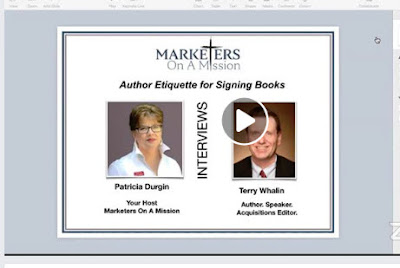
Last week instead of interviewing another person, Patricia Durgin interviewed me on Facebook Live. I loved Patricia's preparation and questions for this hour-long interview. You can follow this link to watch the interview.

Do you interview others? Has it helped you grow as a writer? Let me know your experiences and tips in the comments below.

Tweetable:


Discover interviewing others is a way to grow as a writer. Get insights from this prolific journalist and author. (ClickToTweet)


Labels: , , , , , , , , , , , ,

____________________________________

Tuesday, October 04, 2016


Are You Asking Questions and Getting Answers?


At the recent Colorado Book Festival, I had the opportunity to meet the Governor of Colorado, John Hickenlooper.  The Governor was the opening speaker at the Festival and also signed copies of his new memoir, The Opposite of Woe.  I watched him interact with readers and admired his broad stroked signature and how he personalized each book during the event. I noticed his writing on the title page of each book matched the style of printing on his book cover. In fact, I made a comment about it and he said that he had pushed the publisher in the production process about this very element—to make sure it matched.

In a lull in his book signing, I asked Governor Hickenlooper a question, “If I give you a copy of my book, would you read it?”

Governor Hickenlooper gave an honest answer, “Terry, probably not. I'm severely dyslexic and only read about four books a year.” As a life-long reader and book person, I found the information surprising. You can see some of the books that I've recently read or heard on my Goodreads book page. Every government official must have stacks of material to be reading but he has found another way to succeed.

“Governor, is your book available on audio?”


“Absolutely,” he said, “In fact I spent six or seven hours recording my book.” I was intrigued with The Opposite of Woe but decided not to purchase the physical book but to get the audio version through Overdrive. This conversation took place in the main Denver Public Library yet the Governor's book wasn't available at this library. I continued searching and found it at another Colorado library.  I've started listening to his book and will soon complete it. I was impressed with the Governor's honest answer and exchange.


The experience made me think about my newest book, Billy Graham, A Biography of America's Greatest Evangelist. The book has been out for a year and continues to sell and be well-received. When I speak with other writers, they will often ask me about the book sales and if I'm happy with them. I respond that like every author I would like to sell more books and how I'm continuing to promote and work at telling new people about the book.

I've received great feedback about Billy Graham. If you check the link, you will see the endorsements from some easily recognized leaders and the book has 45 reviews on Amazon. I'm grateful the book is out in the bookstores and continuing to sell. You can hear this recent radio interview about the book and see that I'm continuing to promote the book. This process is what every author has to do to continue to reach readers. Am I “happy” with the sales? No so I don't blame anyone or complain. Instead I redouble my efforts to create new opportunities to expose others to the book. It is the journey of every active author.

What about your writing life? Are you “happy” with your book sales? If not, look for new opportunities to reach new readers. As one of my writing teachers told me years ago, “writers are surrounded by a sea of ideas. The key is which idea you develop and move forward.” 

I hope you are asking questions and getting answers in your own writing life. I also hope you've learned some important tips from my own experiences. If I can help you, don't hesitate to reach out to me and ask. My work contact information is at the bottom of the second page of this link. Asking questions is one of the best tools any writer has to move forward.

Tweetable:

Are you asking questions and getting answers? Learn from this writer's experiences. (ClickToTweet)

AddThis Social Bookmark Button


SocialTwist Tell-a-Friend

Labels: , , , , , , ,

____________________________________

Friday, August 14, 2015


Flexible Learning

As a writer and editor, I’m constantly learning and trying new programs or new tools or new ways to explore opportunities and grow. I’ve written about a number of different opportunities in these entries in The Writing Life such as:
Today I want to highlight one more opportunity which has great flexibility: podcasts.  Many people are using this tool to get their message and information out to new people. As an author or entrepreneur, you can learn how to create a podcasting course. Just follow the link to learn more about how you can create a course. Podcasting is another tool that you can use as an author to build your audience and establish yourself as an expert.
There are thousands of podcasts with great information for you to learn about almost any subject. Many of us are carrying a smartphone with us. Make sure you have the podcast app on your phone. Then through iTunes you can search for podcasts which appeal to you and subscribe to the podcast.  As that podcast adds more programs, you can download the program on your phone and listen to it whenever you want.
Many people listen to podcasts as they exercise or walk. If I don't have something like a podcast to engage my mind, I find exercise is boring. If I exercise while listening to a podcast, I can gain some new insights during the process. My local church puts past sermons on podcasts. There is an endless variety of topics and subjects for podcasts.
Four Possible Podcasts
I'd like to highlight three different podcasts for writers and authors. I selected these podcasts because they are long enough to have some substance to them and with valuable insight for every author or would-be author. I recommend you listen to several of these podcasts and see if the content helps you. If not, try something else which will help you with your writing life.
Recently I was on a live radio show It’s all About the Questions with Laura Steward. Our interview was a live AM radio broadcast throughout Florida. To Laura's credit, she also recorded  and edited this this broadcast as a podcast. Follow this link to hear our interview.  I love the flexibility of this interview. You can download it to your desktop or your phone or catch it as a podcast.
Writers and Authors on Fire is another recommended podcast. I've known the host John Vonhof for many years. The quality of the interviews and the information for writers is excellent. I've heard a number of these interviews and appreciated the contents. John interviewed me and here is my recent podcast at Writers and Authors on Fire.
Another podcast that I've been listening to is Authorpreneur with Jim Kukral. I've heard several of these interviews and appreciated the information and education for authors in this podcast.
Finally I recommend Author U, Your Guide to Book Publishing by Dr. Judith Briles. I've known Judith for many years and she has a large volume of podcasts and many different topics in this podcast. I would encourage you to download several of them and gain from this information.
You may like a different set of podcasts. My main point in this article is to celebrate these flexible learning tools but also to encourage you to listen to these resources—or even start your own podcasting course.
Which podcasts do you listen to? Let's get your ideas in the comments.

AddThis Social Bookmark Button
SocialTwist Tell-a-Friend

Labels: , , , , , , , , , , , , , ,